FlexPath: Learned Semantic Path Priors for Image-Based Planning

1 Fraunhofer IVI     2 Technische Hochschule Ingolstadt
*Equal contribution
Preprint
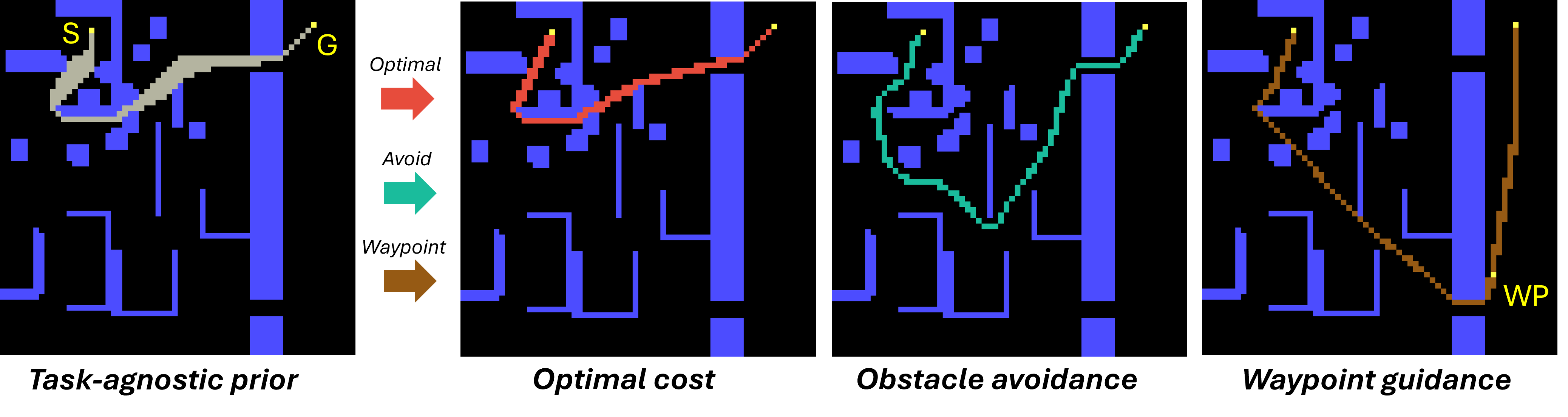
FlexPath overview figure

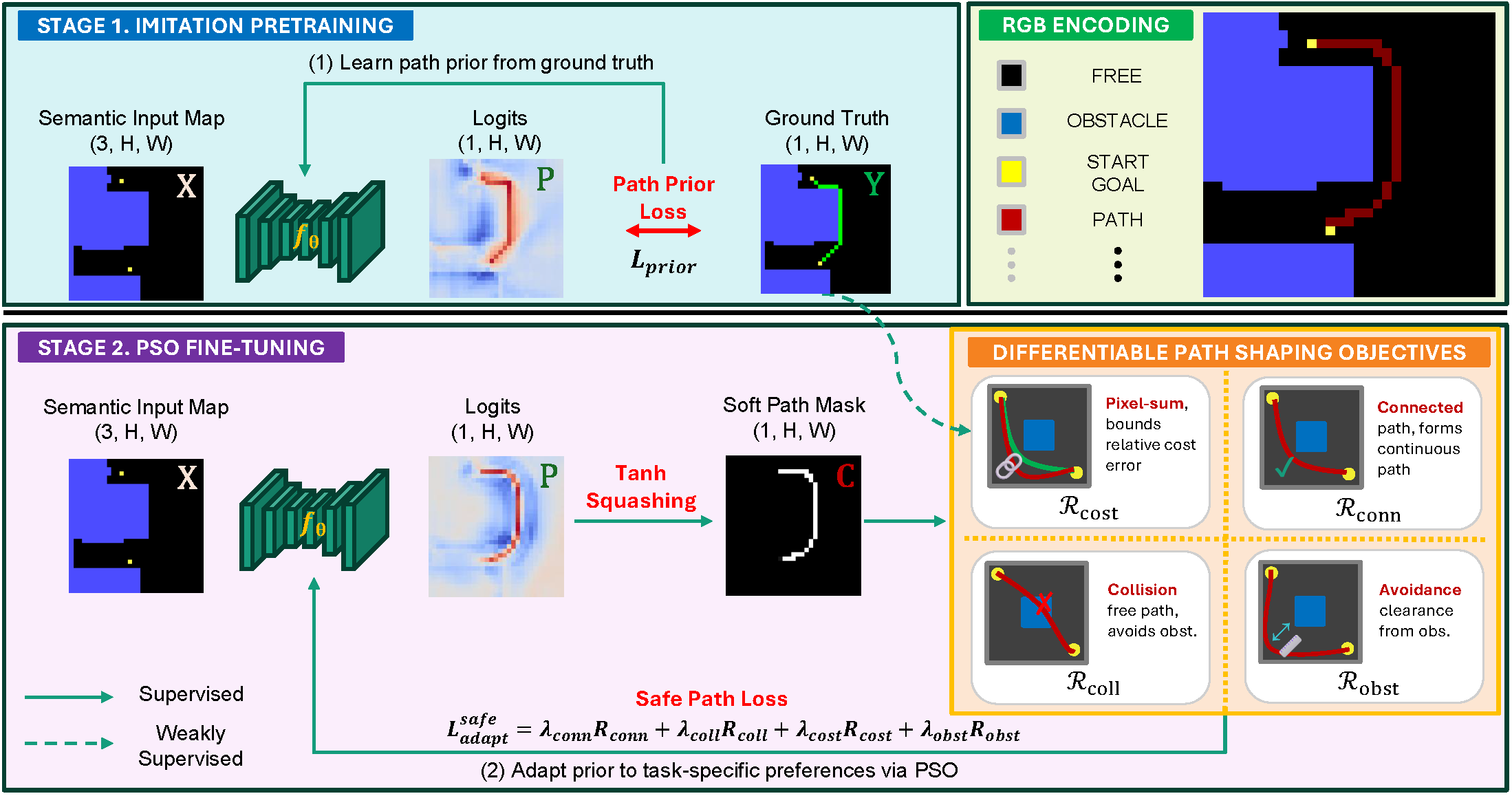
FlexPath. A single pretrained model adapts to multiple planning objectives without retraining. Given the same visual map, FlexPath generates a task-agnostic feasibility prior (Stage 1) that is then steered toward shortest-path, obstacle-clearance, or waypoint-guided routes via differentiable Path Shape Objectives (Stage 2).

Abstract

Recent learning-based path planners use neural networks to process visual map representations and approximate heuristics for classical search algorithms, yielding near-optimal paths with reduced search effort. However, these methods are tied to the shortest-path objective implicit in their supervision, which limits their flexibility to accommodate alternative criteria.

FlexPath introduces a two-stage framework that decouples feasibility from preference. In Stage 1, imitation learning acquires a task-independent spatial prior over feasible paths from visual map inputs. In Stage 2, differentiable Path Shape Objectives (PSOs) adapt this prior toward task-specific criteria without relearning path structure. A single pretrained model can be adapted to multiple objectives.

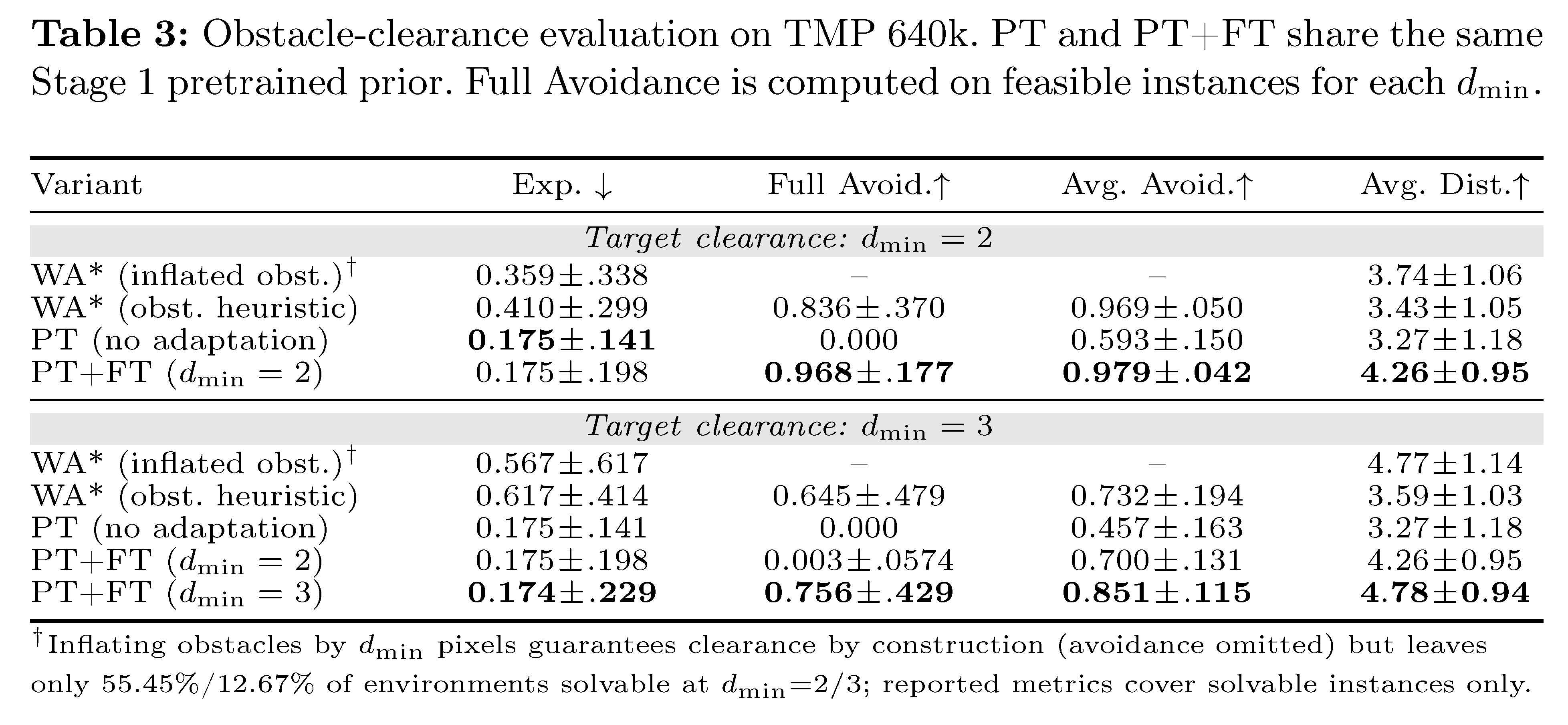
For shortest-path planning, FlexPath reduces search effort on TMP by 14.3% compared to TransPath while also finding lower-cost paths and demonstrating strong zero-shot generalization across three unseen domains. For obstacle clearance (dmin = 2), it achieves 96.8% full obstacle avoidance while maintaining low search cost. The framework extends to semantic-aware avoidance and waypoint guidance via objective-level adaptation.
Method Overview

FlexPath separates the learning of where paths can go from which paths are preferred.

FlexPath method overview

Two-stage framework. Stage 1 (top): a neural network learns a task-agnostic feasibility prior via recall-biased imitation learning on rasterized planner demonstrations. Stage 2 (bottom): the prior is adapted through differentiable Path Shape Objectives (PSOs) encoding task-specific preferences — including connectivity, collision avoidance, cost minimization, and semantic clearance — without relearning path structure.

Results

Shortest Path Planning

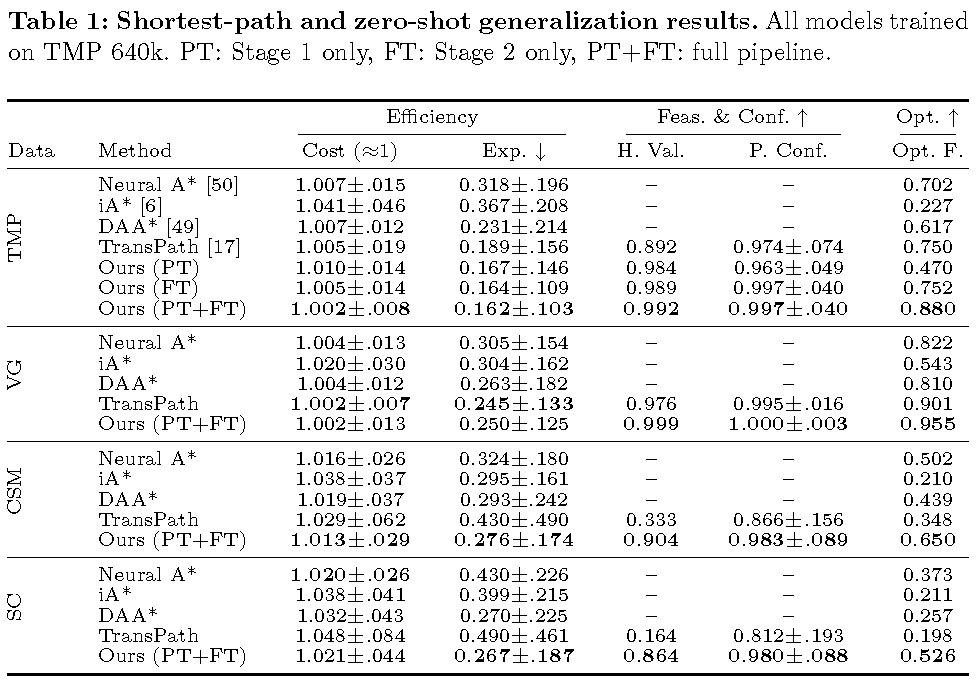
Main results table on TMP benchmark

Quantitative results on TMP. FlexPath reduces search effort by 14.3% compared to TransPath while finding lower-cost paths across out-of-distribution maps.


Optimality vs clearance-aware paths

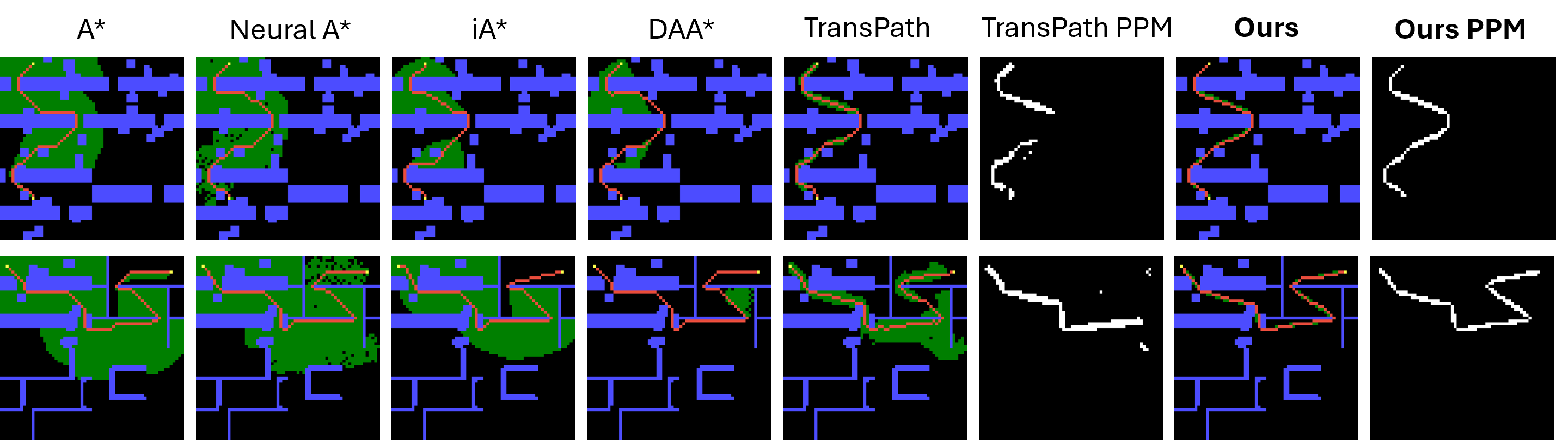
Qualitative comparison on shortest-path planning. Expanded nodes (green) and resulting paths (red) for A*, Neural A*, iA*, DAA*, TransPath, and FlexPath across multiple map instances. FlexPath explores fewer nodes while recovering paths of comparable quality to the baselines.


Out-of-distribution generalization

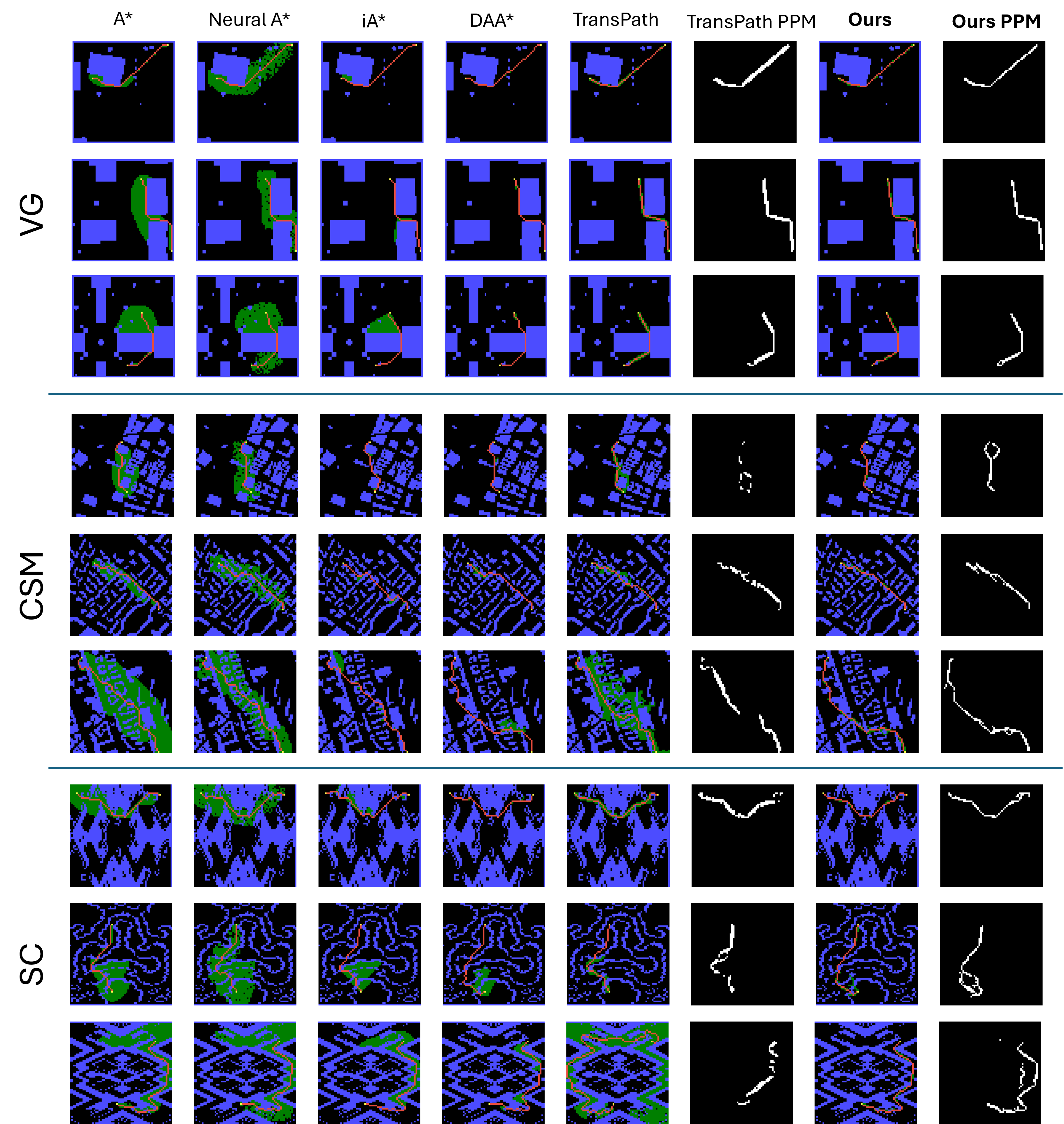
Zero-Shot Out-of-Distribution Generalization. FlexPath generalizes to unseen map domains (VoxelGym, City/Street Map, StarCraft) without fine-tuning, demonstrating that the learned feasibility prior captures domain-agnostic spatial structure.

Distance & Semantic-Aware Planning

Distance and semantic clearance results table

Obstacle-clearance evaluation on TMP 640k. Stage 2 adaptation steers the pretrained prior toward clearance-constrained paths without retraining. At dmin = 2, FlexPath achieves 96.8% full obstacle avoidance while maintaining low search cost comparable to the shortest-path variant. Performance degrades gracefully at the tighter dmin = 3 threshold, outperforming both WA* baselines in full avoidance rate.


Semantic-aware avoidance and waypoint guidance

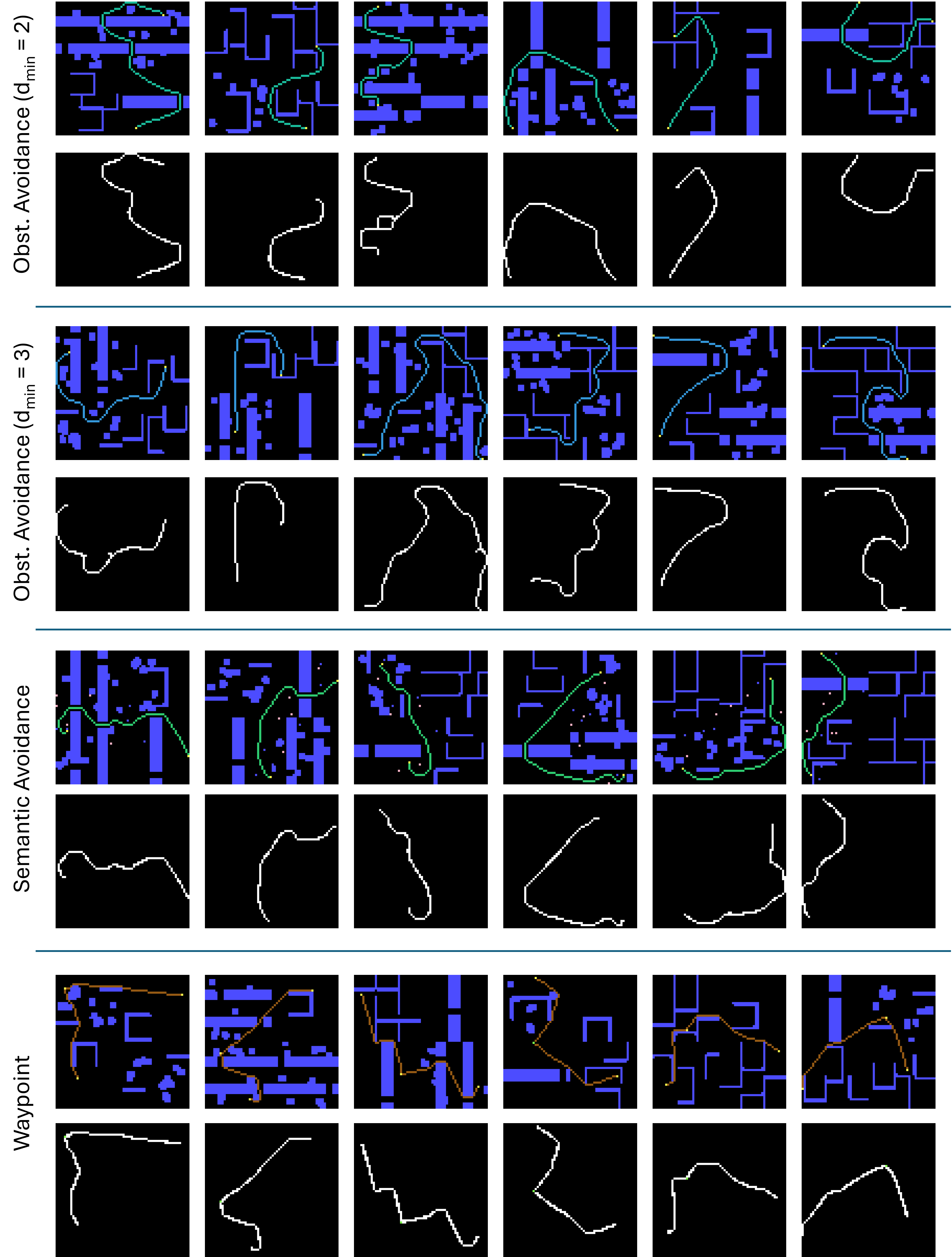
Semantic-aware clearance and waypoint guidance. Left: A second semantic obstacle class (pink) requires a larger minimum clearance of dmin = 4 pixels compared to dmin = 2 for standard obstacles. The adapted model maintains the required clearance in 70.5% of test environments while preserving strong avoidance of standard obstacles — all via Stage 2 objective adaptation, without redesigning the planner or cost map. Right: Waypoint-guided planning. Intermediate waypoint pixels (WP) act as soft constraints; the adapted model successfully routes start → waypoint → goal in 98.3% of test cases.

Qualitative Comparison

Qualitative comparison on TMP 640k

FlexPath across Stage 2 objectives. A single pretrained model adapted to four distinct objectives via Stage 2 PSO fine-tuning: obstacle avoidance at dmin = 2, obstacle avoidance at dmin = 3, semantic-aware clearance, and waypoint guidance. No retraining is required — only the Stage 2 objective changes.

BibTeX

@misc{FlexPath2026,
  title         = {FlexPath: Learned Semantic Path Priors for Image-Based Planning},
  author        = {Taehyoung Kim and Tim Sch{\"o}nbrod and David Eckel and Henri Mee{\ss}},
  year          = {2026},
  eprint        = {2026.00000},
  archivePrefix = {arXiv},
  primaryClass  = {cs.CV},
  url           = {https://arxiv.org/abs/2026.00000}
}